
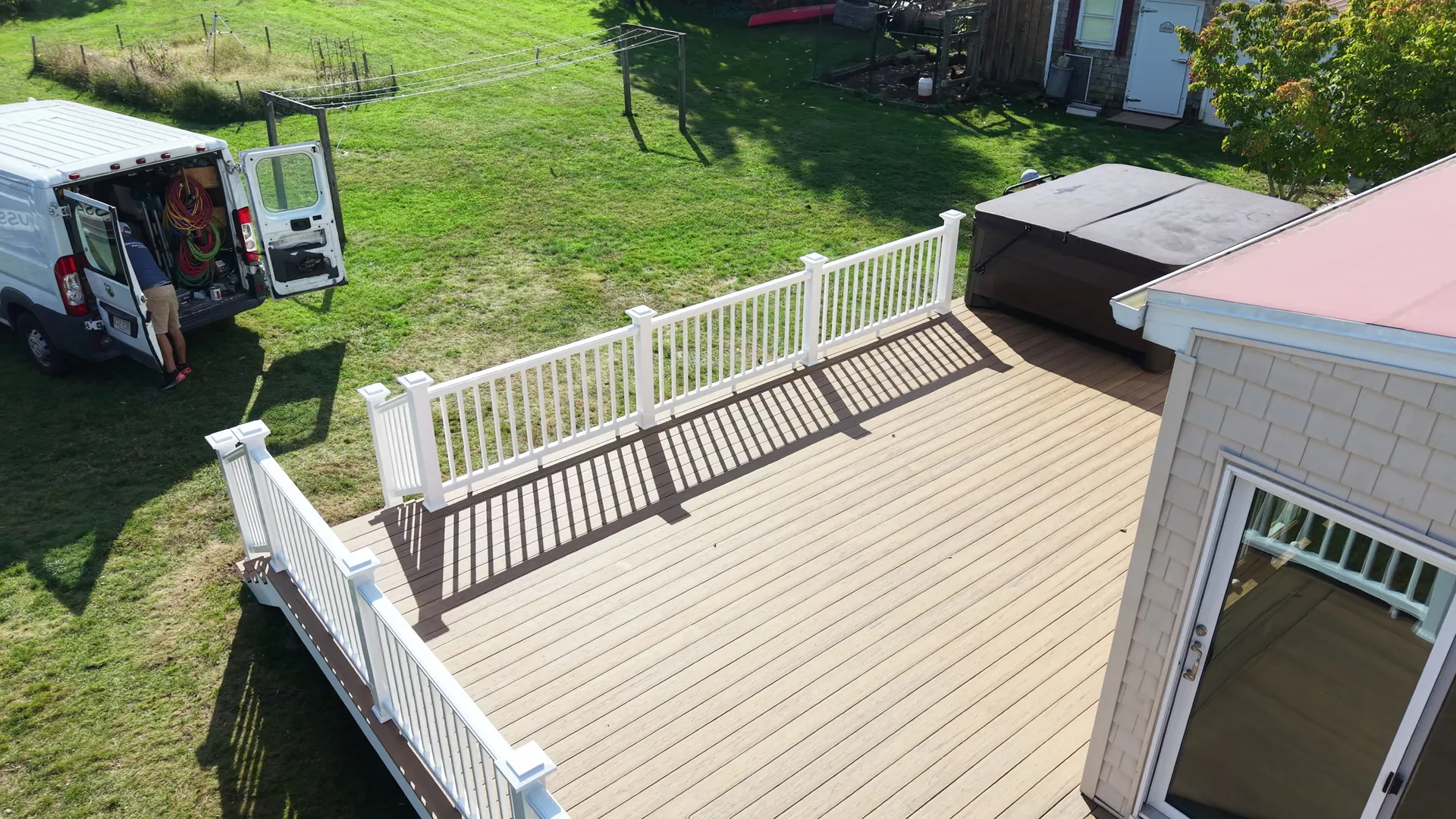
A new deck on Cape Cod usually costs in the tens of thousands of dollars, not the few thousand a lumber list suggests. The most recent public benchmark, the 2025 Cost vs. Value report, puts a 16-by-20-foot composite deck at $25,817 in New England and the same deck in pressure-treated wood at $20,603. Here is what those numbers include and what changes them on the Cape.
What the benchmark deck includes
The Cost vs. Value report prices the same project in every region: a 16-by-20-foot deck (320 square feet) on pressure-treated joists, supported by 4x4 posts on concrete piers, with a built-in bench and planter, three steps down to the yard, and a full railing. The composite version uses composite boards and a matching composite railing. The wood version uses pressure-treated boards and a wood railing.
The per-square-foot figures below divide the job cost by those 320 square feet. Use them as a rough guide, not as a quote.
| Deck | New England | U.S. average | Per sq ft, New England |
|---|---|---|---|
| Composite | $25,817 | $25,096 | about $81 |
| Pressure-treated wood | $20,603 | $18,263 | about $64 |
What makes a Cape Cod deck cost more or less
The boards are only part of the price. These are the things that move it the most:
- Size and shape: every corner, angle, and extra level adds framing and labor.
- Height off the ground: taller posts, bracing, and long stair runs, especially on second-story decks.
- Stairs and landings: each run of stairs is its own small structure.
- Railings: composite, PVC, wood, and cable railings all price differently, and railings run the full length of every open edge.
- Hot tubs and heavy loads: bigger beams, closer joists, and larger footings.
- The site: sandy soil, slopes, ledge, and tight access all change the footings and the labor.
- Flood zones and the shoreline: design changes and the Conservation Commission review take time.
- Tearing out an old deck: removal and disposal come before anything new goes up.
- Hardware near salt air: stainless or hot-dip galvanized connectors cost more than standard ones, and they are worth it.
How to estimate your deck
Start with the area: length times width. Multiply by about $64 per square foot for a basic pressure-treated deck or about $81 for composite, based on the New England benchmark. Then add for anything the benchmark does not have, like more height, more stairs, a premium railing, a hot tub platform, or a tear-out.
For example, a 12-by-16-foot composite deck (192 square feet) works out to roughly $15,500 at the benchmark rate, before any of those extras. That is a ballpark. The number you can plan around is a written estimate after someone has looked at your house and your yard.
Permits and approvals are part of the price
A new deck needs a building permit from your town, with footings set below the frost line the Massachusetts building code requires. Within 100 feet of a wetland, coastal bank, dune, or salt marsh, the Conservation Commission reviews it. In the Old King’s Highway district along Route 6A, a deck that can be seen from the street needs a historic certificate. These steps take time and sometimes change the design, so they belong in the budget from the start.
Is a deck worth what it costs?
In the same 2025 report, a composite deck in New England recovered 95.8 percent of its cost at resale, and a wood deck 79.1 percent. Resale is only part of the story on the Cape, where a deck gets used from spring through fall.