
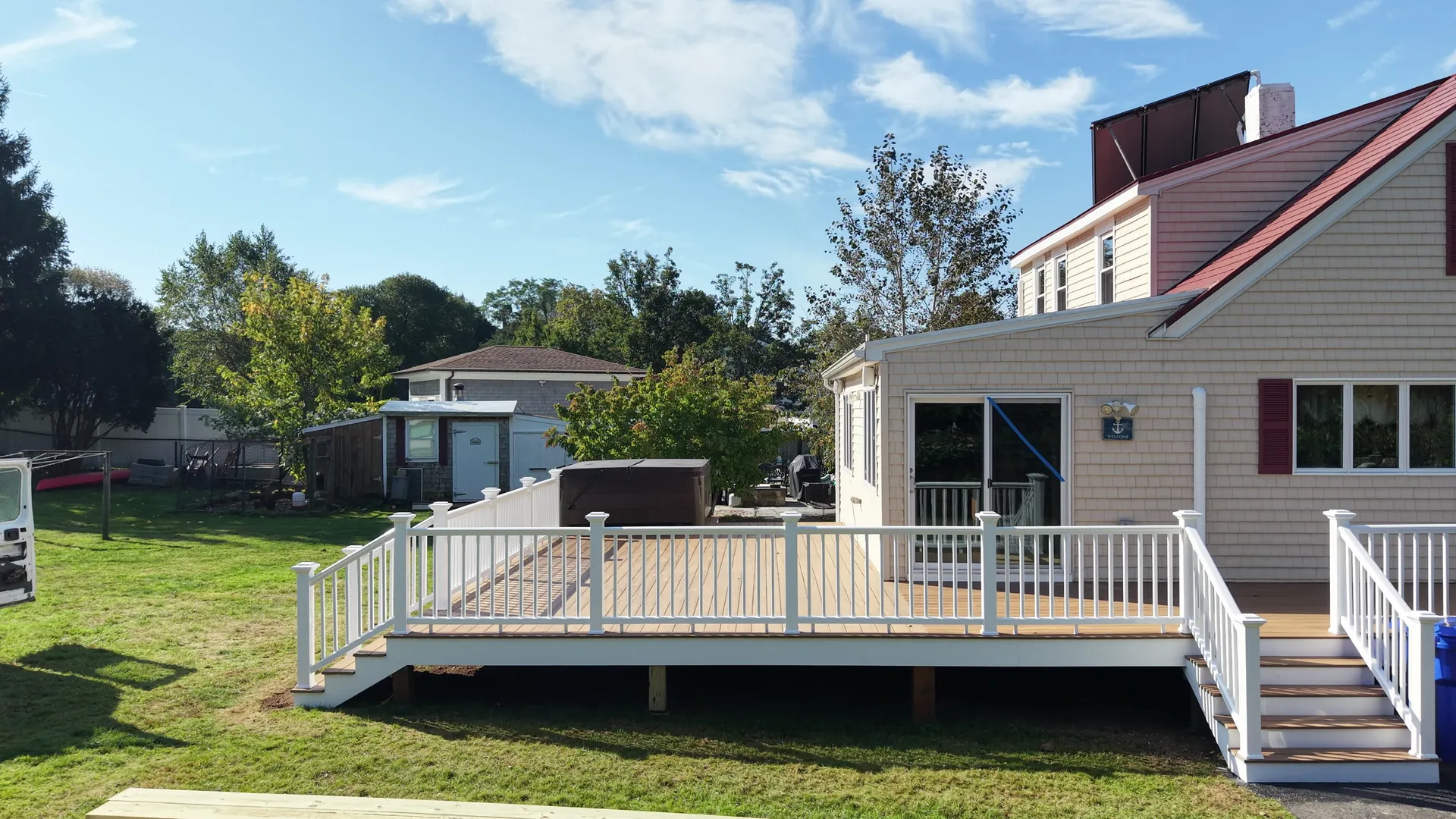
Composite decking costs more up front than wood, and the gap is smaller than many people expect once the whole deck is priced. In the 2025 Cost vs. Value report, a 16-by-20-foot composite deck averaged $25,817 in New England, against $20,603 for the same deck in pressure-treated wood.
Where the money goes
On a composite deck, only the surface changes. The posts, beams, and joists are pressure-treated lumber in both versions of the benchmark deck, and so is most of the labor that goes into the footings and the framing. What costs more is the decking itself and everything that has to match it:
- The deck boards.
- A matching composite or PVC railing system.
- Hidden fasteners or clips, which many composite boards use instead of face screws.
- Fascia and trim boards that cover the framing around the edges.
- Composite stair treads and risers.
Composite, PVC, cedar, and pressure-treated wood
The four common deck surfaces on the Cape, and what each one asks of you over time:
| Material | Upkeep | Notes |
|---|---|---|
| Pressure-treated wood | Clean and stain on a regular schedule | Lowest up-front cost; can split, check, and splinter as it weathers |
| Cedar | Clean and seal on a regular schedule | Natural look and smell; softer than the other options |
| Composite | Wash it; no sanding or staining | Wood fibers and plastic; heavier boards |
| PVC | Wash it; no sanding or staining | All plastic, no wood fibers; lighter boards |
Installation details that matter on the Cape
Composite boards are installed to the manufacturer’s instructions, and the warranty depends on it. That usually means joists spaced closer than a wood deck might need, especially for diagonal patterns, and the gaps the manufacturer calls for so the boards can expand and contract with the seasons.
Near the water, the screws, hangers, and bolts should be stainless steel or hot-dip galvanized. Low decks need airflow underneath so the wood framing can dry out. Darker composite and PVC boards can get hot in full summer sun, so color is worth thinking about on a south-facing deck.
When composite pays for itself
A wood deck needs cleaning and a new coat of stain on a regular schedule to stay in good shape, and each round costs time or money. Composite skips that cycle. In the 2025 report, a composite deck also recovered a larger share of its cost at resale in New England than a wood one, 95.8 percent against 79.1 percent.