
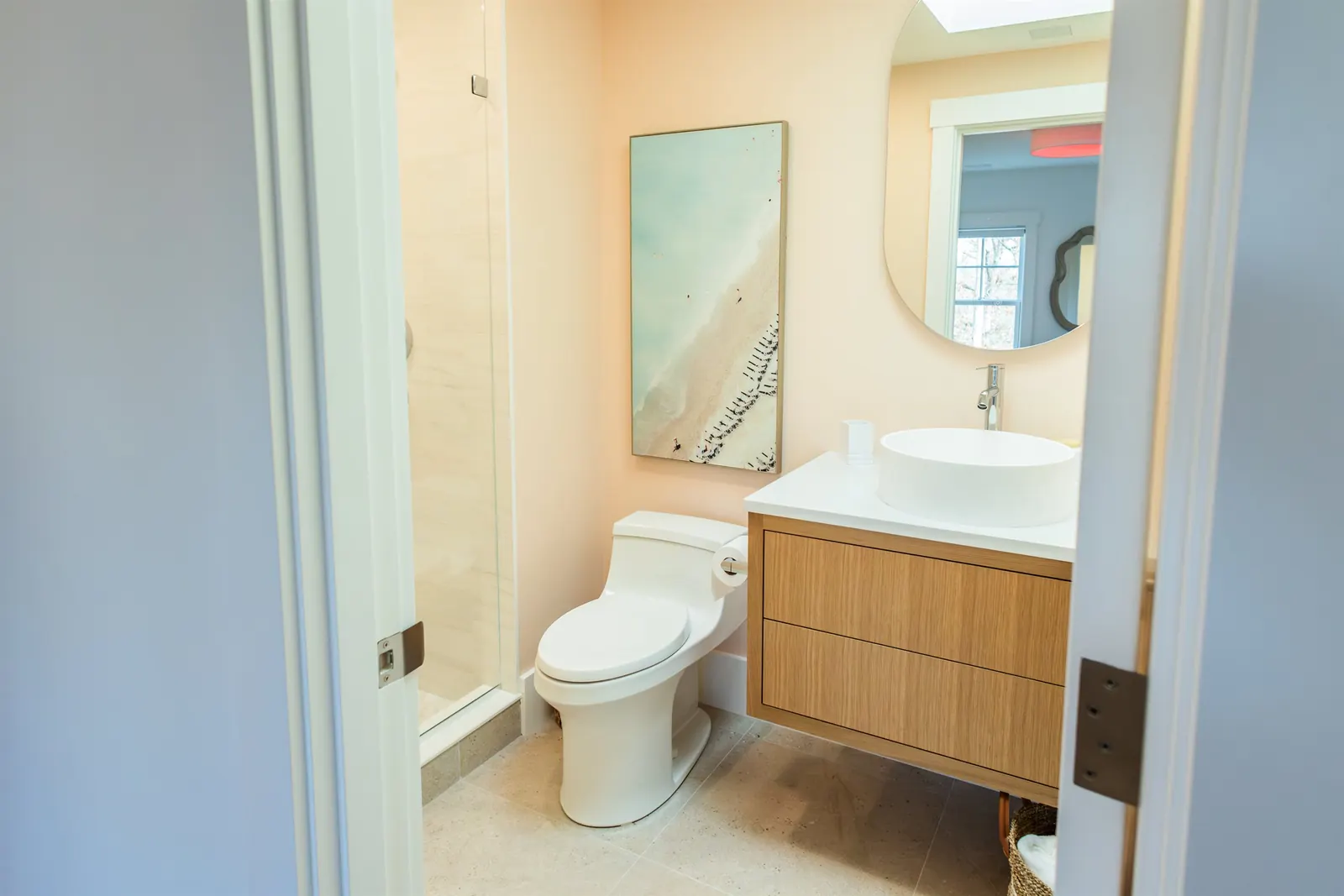
Most basements can take a bathroom. The deciding question is where the drain goes: if the new toilet and shower sit below the house’s main drain line, the waste has to be pumped up. After that come venting, a fan that moves damp air outside, enough ceiling height, and a licensed plumber with a permit.
Gravity or a pump
If the main drain leaves the house below the basement floor, a new bathroom can often drain by gravity, which means cutting the slab to run new pipe. If the main drain leaves above the floor, the bathroom needs a pump. A sewage ejector sits in a sealed basin below the floor and pumps everything up to the main line. An up-flush system does the same job from a unit behind the toilet, with less concrete work.
Venting and moisture
Every fixture needs a vent to drain properly, tied into the house vent system. And because basements already run damp, the bathroom needs an exhaust fan vented to the outside, not into the ceiling, plus moisture-resistant materials on the walls and floor.
Layout and ceiling height
The building code sets a minimum ceiling height for finished space, and beams, ducts, and pipes often run lowest right where a bathroom wants to go. Placing the bathroom near the main stack and the existing plumbing keeps the drain runs short and the cost down.
What it costs
A basement bathroom is usually priced as part of a basement project. The 2025 Cost vs. Value report prices a basement remodel that finishes a 20-by-30-foot space with a wet bar and a 5-by-8-foot full bathroom at $54,505 in New England and $52,012 nationally. A stand-alone bathroom costs less, but a pump, slab cutting, and long drain runs add to it.
| Region | Job cost |
|---|---|
| New England | $54,505 |
| U.S. average | $52,012 |
Permits and septic
In Massachusetts, the plumbing goes in under a permit pulled by a licensed plumber, and the wiring under an electrical permit. A new bathroom by itself does not change the number of bedrooms Title 5 uses to size a septic system, but if the plan also adds a bedroom, the Board of Health reviews the septic capacity first.